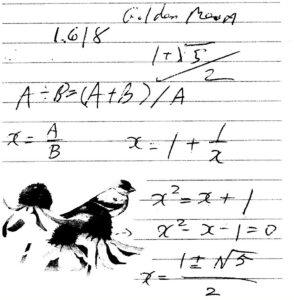
During the 2019 seminar in South Carolina, Hashimoto sensei forwarded to me an enigmatic note, shown in Fig. 1. It was a brief review of the Golden Ratio. An attached memo said that it “refers to the proportions of the yumi.” I followed his hint and explored the manifestations of the Golden Ratio in the proportions and the shape of a yumi. My main results are highlighted below. The full article gives the mathematical and experimental details.
Fig. 1: The original note from Hashimoto sensei.
The Golden Ratio: A mathematical expression of aesthetics
In the fifth century BC, the Greek sculptor and mathematician Phidias proposed the division of a line segment into two with “the most beautiful” proportions. As seen in Fig. 2, this division defines not two, but three lengths, in the descending order
a+b – the total length,
a – the length of the greater segment,
b – the length of the lesser segment.
Fig. 2: Three lengths defined by division of a line segment into two.
Phidias imposed a certain symmetry between these lengths: The total (a+b) stands in relation to the greater (a), the same as the greater (a) to the lesser (b). Stated mathematically, the ratios (a+b)/a and a/b must be equal to the same number: the Golden Ratio ϕ:
(a+b)/a = a/b = ϕ ≈ 1.61803…
The Golden Ratio is a mathematical form arising from pure aesthetics.
Phidias originally applied the Golden Ratio to set proportions in human figure sculptures of the Parthenon temple. Once released into world culture, the Golden Ratio strongly insinuates itself in artistic and architectural works over the two and a half millennia since Phidias. Here is an example in Kyudo, very much in the original spirit of Phidias: On page 132 of the Kyudo Kyohan, there is an idealized line drawing of Kai. Superimposed upon it, there is the central vertical axis of the Kyudoka, and the three horizontal lines of shoulders, hips and feet, as in the Sanjumonji (three crosses). In the figure, the elevation of the shoulder line above the feet is 76.5 mm, and the elevation of the hip line, 47.5 mm. The ratio of these elevations is 1.611, close to the Golden Ratio ϕ ≈ 1.61803…
Golden Ratio in Yumi
Let’s examine the proportion between yumi lengths above the top of the grip (a), below (b) and total (a+b).
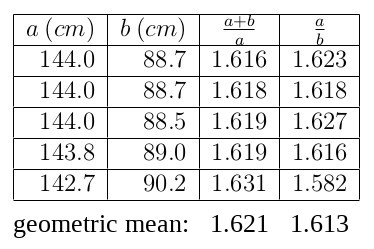
Fig. 3: Golden Ratio tested in five Yonsum yumi.
Fig. 4: Kaniwara: an ancient Chinese aesthetics of dividing a line into six segments. Seven white nodes are considered Yang and six black segments are considered Ying.
The table in Fig. 3 shows the measurements of lengths a and b, performed on five Don Symanski Yonsun yumi. The third and fourth columns report the ratios (a+b)/a and a/b: they all are close to the Golden Ratio ϕ =~ 1.61803… We obtain an even better agreement when we compute geometric means: 1.621 for the third column and 1.613 in the fourth column. Thus, the grip placement according to the Golden Ratio is very nearly realized for the five yumi.
Was grip placement according to the Golden Ratio consciously articulated by some yumishi long ago? I have no idea. There are other ancient mathematical expressions of aesthetics with closer proximity to Kyudo. Hashimoto sensei shared with me an ancient Chinese aesthetics called “Kaniwara.” Divide a line segment into six equal portions, illustrated in Fig. 4. The seven endpoints of segments marked by white dots are “Yang.” The six intervals between adjacent pairs of endpoints, marked in black, are “Yin.” Now look at the bamboo nodes of the yumi in Fig. 5.
Fig. 5: White dots are back nodes. Black dots are belly nodes.
The back of the yumi that faces the target is “Yang”, with seven “Yang” nodes, also marked by white dots. The belly of the yumi facing the archer is “Yin,” and halfway between any pair of of “Yang” nodes on the back, there are “Yin” nodes on the belly, six of them in all. The fourth belly node from the top marks the top of the grip. If all spacing between nodes are equal, then the ratio of lengths above and below the grip is 1.5, not too far from the Golden ratio ϕ ≈ 1.61803. In practice, the node spacing increases gradually as you ascend a bamboo stalk. Naturally, yumishi orient the back and belly bamboos in the upward direction, and the ratio of lengths increases somewhat. In practice, the Golden Ratio of length proportions is very nearly achieved. (More on this in the full article)
Curve proportions
Imagine facing a braced yumi so you gaze along its back. In Fig. 6, with the yumi oriented horizontally, you are looking from above. From this perspective, the top and bottom curves are concave. This appears to be a natural choice consistent with most archery traditions everywhere and throughout the ages. The curve containing the grip is concave as well, as if yumishi wanted to impart some extra Ikasu (“life”) about the grip. The mathematics of curves dictates that concave and convex curves must alternate, so there must be at least one convex curve above the grip, and at least one other below. The yumi displays a sequence of five curves: concave, convex, concave, convex, concave. Each pair of adjacent curves is connected at the inflection points; in the figure, the approximate positions of the four inflection points are marked by hollow dots.
Just as we examine these proportions of yumi lengths above and below the grip, we examine geometric proportions of the curves in relation to each other. First, we examine the proportions seen in actual yumi. Then we propose a mathematical expression of these proportions which closely reproduces what we see in typical yumi.
Fig. 6: The five curves of a yumi, seperated by four inflection points (hollow dots). The length h of the arrow indicates the elevation of a curve midpoint relative to the cord line.
Consensus Shape of a Well-Proportioned Yumi
We quantify yumi curves by their lengths and depths.
The length of a curve is measured by a cloth tape measure hugging the back of the yumi between endpoints.
The depth, or elevation h of each curve is the displacement of the curve’s midpoint relative to its chord. The chord between endpoints is realized physically by a connecting thread (see the Fig. 5). We measure the distance from the midpoint of the thread to the back of the yumi. The elevation is assumed positive for convex curves, negative for concave curves.
The blue curves in Fig. 6 depict individual shapes of the five Don Symanski yumi: Photographs are imported into a graphics program and the blue curves are obtained by tracing along the back bamboo. The red curve represents an “consensus” shape, based on averaging the lengths and depths of the curves of the five individual yumi. Three yumi follow this “average” shape well. Two are outliers: one is weak above the grip, the other is strong.
Fig. 7: Blue curves are individual shapes of five yumi; the red curve is the consensus shape.
The Golden Ratio "hidden" in curve proportions
A yumi is not mirror symmetric about a vertical axis through the grip. Nevertheless we can formulate an analog of mirror symmetry in which curve proportions above the grip are the same as curve proportions below.
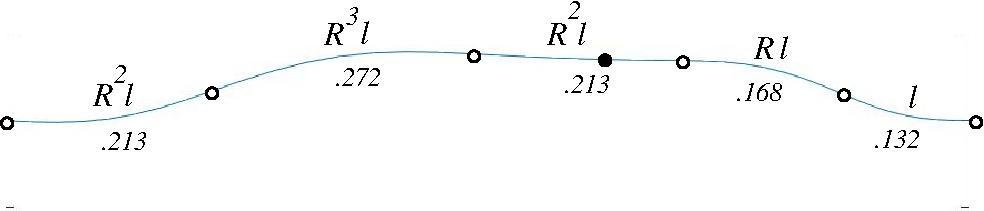
Fig. 8: "Mirror symmetry" of proportions between curve lengths.
Figure 8 visually summarizes this scheme of “mirror symmetric” curve proportions. As in Fig. 6, the hollow dots mark inflection points separating curves and the black dot marks the top of the grip. The symbol l denotes the length of the bottom concave curve. There is a progressive increase of lengths by a common factor R as we ascend from the bottom concave curve to the top convex curve. The progressive increase does not extend all the way to the top concave curve: It’s length is not R4l but rather R2l. In this way we impose a mirror symmetry of proportions between the top two and bottom two curves: The lower convex curve is longer than the bottom concave curve by the factor R , and so is the upper convex curve longer than the top concave curve by the same factor R as well. The upper convex and concave curves are longer than their lower counterparts by the factor R2. The mirror symmetry of curve proportions above and below also dictates that the length of middle concave curve above the grip is also R2 times the length below.
The factor R is related to the Golden ratio ϕ: The proceeding construction implies that the total length a above the grip is R2 times the length b below. In this way we identify R2 with ϕ, so
R2 = a/b = ϕ,
and then
R = ϕ1/2 ≈ 1.27202.
The proportions of curve lengths are now uniquely determined.
Assigning curve depths is more subtle. Details are discussed in the full article. In particular, the upper concave and convex curves are geometrically similar to their lower counterparts. The “above” depths are larger than the “below” depths by the Golden Ratio. After imposing symmetry constraints on the depths, there is still freedom to choose the depth of the big convex curve above the grip and the (small) depth of the middle curve. Two further common sense requirements limit the choices: (i) With the tsuru oriented horizontally as in Fig. 6, the yumi should be above the tsuru along its whole length. The tsuru should not wrap itself on either strike plate. (ii) The brace height (Ha) should be close to the standard 15 cm. Given all the curve lengths and depths, we can geometrically construct the yumi shape.
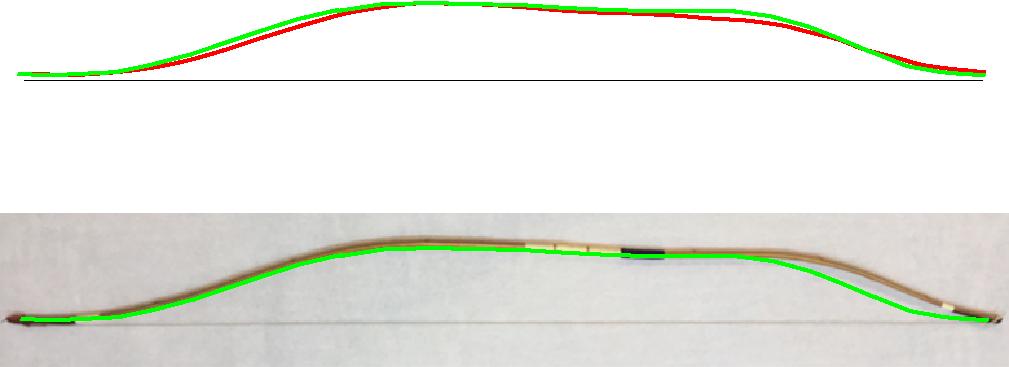
The green curve in the top panel of Fig. 9 is a shape with the “mirror symmetry” proportions as described above. The red curve is the “consensus” shape, the same as in Fig. 7. The bottom panel is a photograph of a Shibata XX yumi after restoration by Don Symanski. He offers it as an example of a well proportioned yumi. The green curve representing the “mirror symmetry” shape tracks the Shibata yumi over the whole length of the top limb, and for some ways along the bottom as well. The divergence of the bottom two curves raises a significant point: For the Shibata yumi and for most yumi in general, the tsuru is not tangent to the yumi limb at the bottom tip. Maybe yumishi don’t want Tsurune happening at both tips. I don’t know. But I do know that the tangency of the mirror symmetry shape at the bottom tip to the tsuru follows from imposing the same curve proportions below the grip as above.
Fig. 9: Top panel: Comparison of the "mirror symmetry" shape (green curve) with the "consensus" shape (red curve. Bottom panel: Comparison of the mirror symmetry shape with the Shibata XX yumi.
Figure 10 is a photograph of a Rokusun yumi made by the author. Its design shape embodies “broken mirror symmetry.” Length proportions of curves stay the same. Only curve elevations change: By straightening the bottom curve, the tsuru is lifted off of the bottom strike plate. The middle curve is made deeper in an attempt to preserve the brace height (Ha).
Fig. 10: Comparison of the "mirror symmetry" shape with a Rokusun made by the author.
Zanshin
The aesthetics of the yumi is expressed by its realizations of symmmetries. In the broadest sense, symmetries refer to aspects of phenomena which remain the same under a change of perspective. Is this why we so readily respond to to them, our hearts recognizing them before our minds catch up? It is tempting to construe symmetries as anchors or reference points in what the meditation teacher Ryushin sensei calls “radical impermanence.” What is that? It is not “things change.” Rather, there are no things, only processes. None are complete unto themselves because they all co-arise. There are no anchors or reference points. And yet, a feeling and longing remain.
The beauty of Don Symanski’s restoration of the Shibata XX yumi is not mathematical perfection. It is unlikely that either yumishi whose hands shaped it impressed any conscious let alone mathematical scheme of symmetry upon it. It stands in proximity to mathematical symmetry, but not quite. I’ve heard it said (I wish I could rmember the source): Artists honor symmetries not in their perfection, but in the subtle breach