
Here are some questions driving the aesthetic and scientific contemplations.
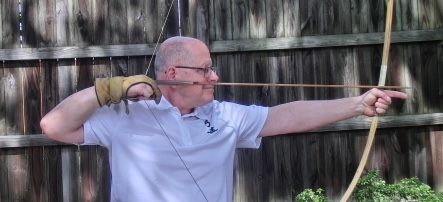
- The Kyohan (Kyudo training manual) expresses aesthetic aspirations of Kyudo and their physical embodiment in the form of the yumi. In particular, the Kyohan says (p. 14): “… the Japanese bow has its grip asymmetrically placed at about one third of its total length …” It goes on to say that this asymmetric division into upper and lower arcs enables “… a continuous elasticity of power evenly distributed throughout the bow to create a perfect condition of balance. ” Against this backdrop of the familiar enters a unique insight that the Hanshi Hashimoto sensei shared with me. He discovered that the proportion of yumi lengths above and below the grip are consistently close to the Golden Ratio of the ancient Greeks. The initial shock of mysticism is tempered some what when you realize how the “magic” intertwines with the practical, traditional rules of yumi making. Are other geometric proportions between the lengths and depths of the five curves also informed by mathematically expressed aesthetics? In modern times, mathematics is often seen as enabling the (seeming) “possession and mastery of nature,” as Descartes once put it. Here, we return to an ancient mode, of mathematics as the very expression of beauty itself.
- Given the desired shape of the braced yumi, what is the unbraced Urazori (reverse curve) shape that should be laminated in the shop to achieve it? Traditionally, one approaches the final Urazori shape by gradual bending and reshaping of an initally extreme Urazori shape. This is possible for traditional take-yumi made of all natural materials. If the design incorporates modern materials, such as carbon laminations underneath the bamboo, there is very little malleability. In this case, the initial lamination process has to achieve the correct Urazori shape at the outset. A precise determination of the Urazori shape based on physics is essential.
- How do you select the appropriate stiffness of ya, given the strength of your yumi and the yazuka (depth) of your draw? Western archers choose arrow stiffness according to arrow selection charts, based on the strength of the bow and the length of the arrow. Information on ya selection for Kyudo is sparse. Sambu Kyuguten’s website gives recommendations for ya based only on yumi strength. The second essential factor of arrow length is not mentioned. There is a physics-based extrapolation of selection charts to the range of ya lengths in Kyudo. Does it really apply to Kyudo? What requirements on ya stiffness really emerge when we take into account the specifics of the Kyudo shot? Do traditional ya really meet the stiffness requirements?
- Traditional take-ya constructed from single stalks of Yadake bamboo are prized for their natural beauty and feel. These positives come at significant costs and vulnerabilities. You have to cut a great deal of Yadake to find four shafts with consistent weight, stiffness and nodal placements. A lot of yard waste for four ya. Bamboo stalks are prone to longitudinal splitting as they dry out. It is highly likely that strong circumferential stresses remain in the finished ya. Traditional construction of bamboo fly fishing rods suggests the possibility of bamboo ya constructed from many thin strips laminated together. If it can be done, uniform mechanical properties are likely realized, and the lay up with multiple glue lines gives consistent and stable straightness. The trick is: How do you do it? How are you going to lay up six or twelve bamboo strips, each much thinner than a match stick?
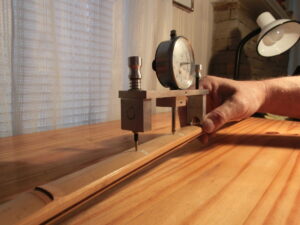
I address some of these questions as I would a scientific problem, based on my training in physics and applied mathematics. For instance, the templates for the Urazori shape that I actually use in the shop are determined by numerical solutions of the equations governing it. The insights on ya selection are dominated by simple dimensional analysis. The practical engineering of shop processes for laminating yumi and ya is less conceptual. There, most of the learning is done with my hands.
 It is certainly pleasing to know how to shape the yumi to achieve classic elegance and grace. There is the thrill of the perfectly flying ya, knowing that your insights made it it so. Nevertheless, Cartesian motivations of possession and mastery are not “the bottom of the bucket.”
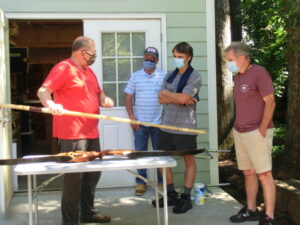
I’ve met Kyudo craftsmen-artists, starting with the recognized yumishi Don Symanski. At Zen Mountain monastery and Toku Dojo in NY, I’ve met others who under Don’s influence naturally gravitated to the art of the yumi and ya. All these people including myself enjoy their work and investigations mainly for process itself. This website reaches out to such kindred spirits.
This learning and knowing, what is its broader context? Why know at all, and why in particular knowing colored by mathematics? In my long experience of mathematics and physics, I’ve felt that this sort of knowing “invites a presence into the room beyond the knowing itself.” This is not new, and has been expressed by greater practitioners than myself. It is mysterious and effervescent, as it must be since it is beyond knowing and so the bottom of the aforementioned bucket “has fallen out.”
To make this material accessible to the general audience, the web pages on this site highlight the main results, aiming to provide intuition without excessive mathematical or experimental details. More scientifically-oriented readers can find all the “nuts and bolts” in the full articles, posted in the PDF format.
