
Ya Selection in Kyudo
In Western archery, the choice of appropriate arrows is informed by selection charts. These are two dimensional arrays in which each row represents a range of bow strengths and the columns, arrow lengths. For instance, the first row of the Easton selection chart represents bow strengths 21-27 lbs (9.5-12.2 kg) in the first row, 27-32 lbs (12.2-14.5 kg) in the second, and so on. The columns correspond to arrow lengths, starting with 23″ (0.584 m) for the first column, 24″ (0.610 m) for the second column, up to 32″ (0.813 m) for the last column. Each combination of bow strength range and arrow length is assigned its appropriate group of arrows. There is a list of arrow groups: arrows in a given group are close to each other in stiffness.
The arrow lengths covered by the Easton chart, 58.4 to 81.3 cm, are too short for Kyudoka, who require lengths between 80 and 110 cm. Japanese dealers such as Sambu Kyuguten provide rough guidelines for arrow selection based on yumi strength alone with no mention of ya length. What is the physically meaningful extrapolation of the Easton selection chart to the range of ya lengths for Kyudo?
Why stiffness of ya matters
On page 71 of the Kyohan it says: “In the full draw (Kai) the arrow must be directed along a line exactly to the center of the target.” Due to the downward arc of the ya trajectory induced by gravity, this should be amended to say: “The ya at Kai should lie in a vertical plane which bisects the target.” The implicit assumption is that the arc of the ya traced after Hanare remains in this plane. A simple shooting test shows that this is not necessarily so.
A first preparatory step is to determine a “sight picture” consistent with correct ya alignment. For the “half moon” sight picture illustrated on page 71 of the Kyohan, the right eye sees half of the mato projecting beyond the left edge of the rattan above the grip. The ya is not part of the sight picture. For our shooting test, we borrow a “point on” sight picture from western Bare Bow archery. The point of the ya appears directly below the center dot of the target, and the sight picture includes some length of the ya behind the point, so alignment of the ya can be sensed directly. To test this process of alignment, a laser pointer is attached to the underside of a long ya, as depicted in Fig. 1. Perform the Hassetsu up to and including Kai. At Kai, the front section of the ya with the laser pointer is in front of the yumi grip. After aligning the ya, search for the laser dot on the plane of the target at a range of about 10 m. The laser dot typically appears above the target’s center at twelve o’clock, indicating that the ya is in the correct vertical plane.
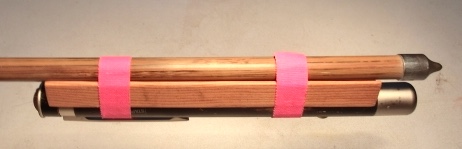
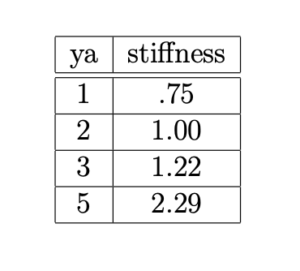
The shooting test begins with a 14.5 kg Rokusun yumi. There are four pairs of test ya, all 102 cm long. Pairs one and two are 1913 and 2015 aluminum shafts and the remaining pairs three and four are bamboo wrapped carbon. The table below lists their stiffnesses relative to the 2015 aluminum ya.
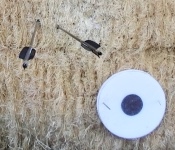
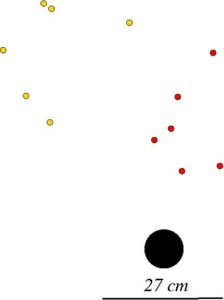
Each pair is shot three times at a range of 21 m, employing the “point on” sight picture described before. Figure 2 is a photograph of a pair of 1913’s in the target. The mato is 27 cm in diameter, so its angular diameter seen at 21 m is the same as for the standard 36 cm mato as seen at 28 m.
We are not concerned with the elevations of the shots, rather with their left/right drift from the vertical line bisecting the target. The photograph is imported into a graphics package. The center dot of the mato is painted over by a black disk of the same size. Impact points are marked by smaller disks. This done, the photograph is deleted from the figure file. The photograph of the next ya pair is imported and the process repeats. In Fig. 3, the blue dots represent impact points of 1913’s, green dots, 2015’s, yellow dots, the softer bamboo wrapped carbon, and red dots, the stiffer bamboo wrapped carbon.
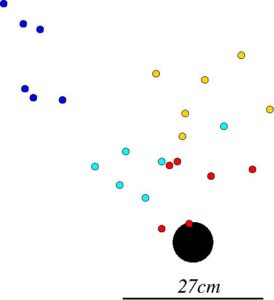
The softest ya, 1913, has the largest leftward drift. In Kyudo parlance, 1913’s “land behind the mato.” So do 2015’s, but with less leftward drift. The softer bamboo wrapped carbon which is 22% stiffer than 2015 has very little drift. The stiffer bamboo wrapped carbon is 229% stiffer than 2015, but it too has very little drift. Apparently, there is a “threshold” stiffness that must be exceeded for the ya to stay in the correct vertical plane after it is launched.
Intuitively, the threshold stiffness should be larger for stronger yumi. Figure 4 shows the impact points of the bamboo wrapped carbon ya shot out of a 19 kg Rokusun. The softer grade of bamboo wrapped carbon lands behind the mato, and the stiffer grade still has very little left/right drift.
Stiffness selection formula
There is an implicit assumption behind the selection charts mentioned at the beginning of this page: The “appropriate” arrow stiffness µ depends only on the arrow length l and bow strength f. If so, we have the simple “stiffness selection formula”
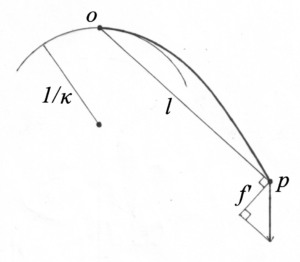
Here, c is a multiplicative constant, the same for all entries in the selection chart. The stiffness selection formula follows from the operational definition of stiffness. In Fig. 5, a uniform rod (aka-the arrow shaft) is clamped horizontally at one end o and a vertical load is applied to the free end p. The rod bends under the load and it has some curvature κ at the clamped end. Recall that the curvature is the inverse radius of the circle which best approximates the bend of the rod near o. The load at p exerts a torque τ on the clamped end, which is the length l of the line segment op times the component f’ of the load perpendicular to op.
Expressed mathematically, the formula for torque is
The constant of proportionality µ is the quantifier of stiffness. The proportionality between torque and curvature is called the torque identity. We see it in other contexts, such as the relationship between braced and Urazori shapes of the yumi in the page “Designing the Urazori Shape of the Yumi.”
Since torque is force times length and curvature is an inverse length, we see that the stiffness µ is a force times length squared. In conventional language, we say that “the units of stiffness are force times length squared.”
The proportionality of recommended stiffness to bow strength times arrow length squared is consistent with balance of physical units, but why this relation and no other? If we change the unit of length by a scaling factor L and the unit of force by scaling factor F, the unit of stiffness changes by the factor F L2. Now take a proposed dependence of µ upon l and f. If we replace l by Ll, and f by Ff, the formula should produce the correct stiffness in units of F L2. The consistency of physical relationships under scaling of state variables is called scale covariance. In particular, scale covariance implies the proportionality of stiffness to bow strength times arrow length squared.
A not implausible refinement of the selection formula replaces the length of the arrow by the actual depth (Yazuka) y of the draw. Given the length l of the arrow and the brace height h of the bow, we have roughly
y = l – h,
and the modified selection formula is
This formula gives good approximations to the actual recommended stiffness in the Easton selection chart with the choices of c and h,
c = 0.1674, h = 17.2 cm = 6.73″.
These values of c and h are obtained from a least squares fit of the selection formula to the actual entries in the Easton chart. The brace height h = 6.73″ is reassuring since brace heights of western bows range between 6″ and 9″.
We can visualize the stiffness selection formula by plotting contours of constant stiffness in the plane whose axes are arrow length on the horizontal and bow strength on the vertical. In Fig. 6, the green rectangle labeled “E” represents the ranges of arrow length and bow strength covered by the Easton chart. The longest arrow length covered by the Easton chart, close to 82 cm, is scarcely longer than the shortest ya length, near 80 cm. The yellow rectangle labeled “K” represents the ranges of ya length and yumi strength that includes most Kyudoka. The four curves represent stiffness contours for four common aluminum ya, 1913, 2014, 2015, 2117. For instance, the contour labeled “1913” represents all the combinations of ya length and yumi strength which are appropriate for 1913 aluminum ya. The four grades of aluminum shafts are common in Western archery as well as Kyudo, and indeed the stiffness contours cover the “middle” of the Easton rectangle. The same contours cover only the upper left corner of the Kyudo rectangle, corresponding to short ya shot from light yumi. In summary, one might say that the common aluminum ya cover the needs of Western archers better than the needs of Kyudoka.
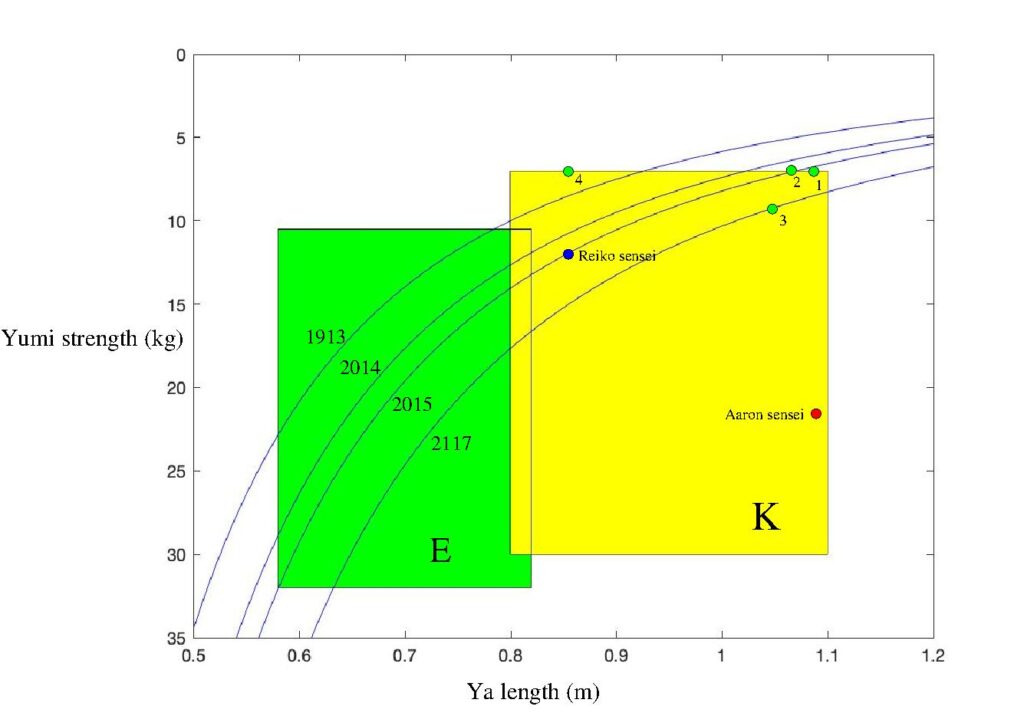
The red and blue dots represent the ya length-yumi strength combinations of sensei Aaron and Reiko Blackwell, respectively. The blue dot lies on the 2015 contour, suggesting that 2015 is a correct ya for her. In fact, her aluminum ya are all 1913, the conventional option for short ya length and light yumi strength. The red dot is far below all four contours, suggesting that none of the common aluminum ya are really appropriate for the long ya length and strong yumi strength that Aaron sensei uses.
Preferences for ya inherited from tradition
What are characteristics of high-end take-ya informed by long standing Kyudo tradition? Four sets of take-ya are examined: Longer and stiffer Shinsa ya of (1) Aaron Blackwell sensei, (2) Ed Symes sensei, (3) Bill Holtz sensei, and shorter, softer ya of (4) Reiko Blackwell sensei. The table below lists their measured physical specifications. The weights of take-ya sets 1-3 are very close 2015’s of the same lengths, and the take-ya of set 4 are only slightly heavier than Reiko sensei’s 1913’s. The stiffnesses of sets 1 and 2 are very close to 2015, and set 3 has a stiffness very close to 2117. Set 4 is slightly softer than 1913. Mechanically, the standard aluminum ya commonly used in Kyudo are close to take-ya counterparts.

Given lengths and stiffnesses of the take-ya, we can compute the appropriate bow strengths according to the stiffness selection formula. In this way we locate points in the plane of arrow length and bow strength corresponding to the take-ya sets 1-4. These are the green dots in Fig. 6. We see that the “appropriate” bow strengths for the longer take-ya 1-3 are in the 7-10 kg range, much weaker than the yumi that Aaron sensei, Ed sensei and Holtz sensei actually use. The recommended bow strength for take-ya 4, close to 7 kg, is still considerably less than the 12 kg strength of Reiko sensei’s yumi.
Ya selection that enables "correct hitting"
The recommended stiffnesses based on the selection formula with the Easton values of the constants c and h may be higher than what actually works for Kyudoka. Here, we readjust the values of c and h. The value of h is the standard brace height (Ha) of 15 cm. In the shooting test, we found that the bamboo wrapped carbon ya 22% stiffer than 2015 shot from a 14.5 kg yumi in fact flies in the vertical plane for “correct” hitting. With the yumi strength (14.5 kg) and ya length (102 cm) given, and h = 15 cm, we can compute the readjusted value of c, c = 0.107, about 2/3 of the Easton value, h = 0.1674. Figure 7 is the redo of Fig. 6, based upon the readjusted values of c and h.
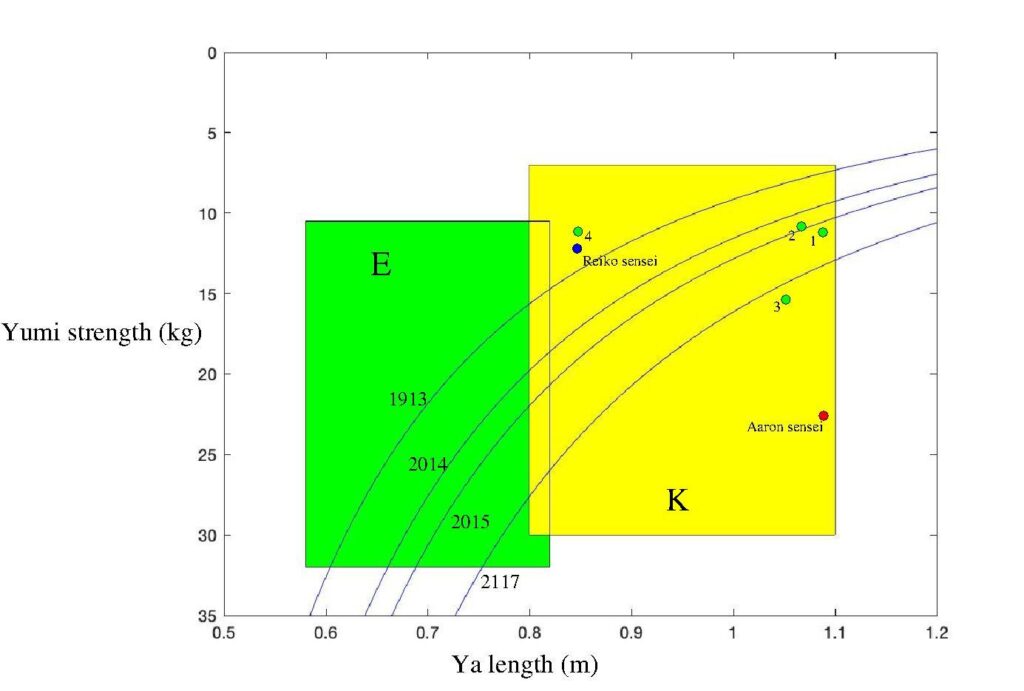
The stiffness contours cover a region closer to a diagonal of the Kyudo rectangle “K.” Reiko sensei’s take-ya appear to be a tad soft for her, but close. The sets 1-3 of take-ya are apparently too soft for Aaron sensei. According the the selection formula with the readjusted coefficients, his combination of ya length, yumi strength is accommodated by a ya 2.24 times as stiff as 2015. Recall that the stiffer grade of bamboo wrapped carbon is 2.29 times as stiff as 2015, so this ya should be a good match for Aaron sensei. He seems to think so, as he has told me.
